

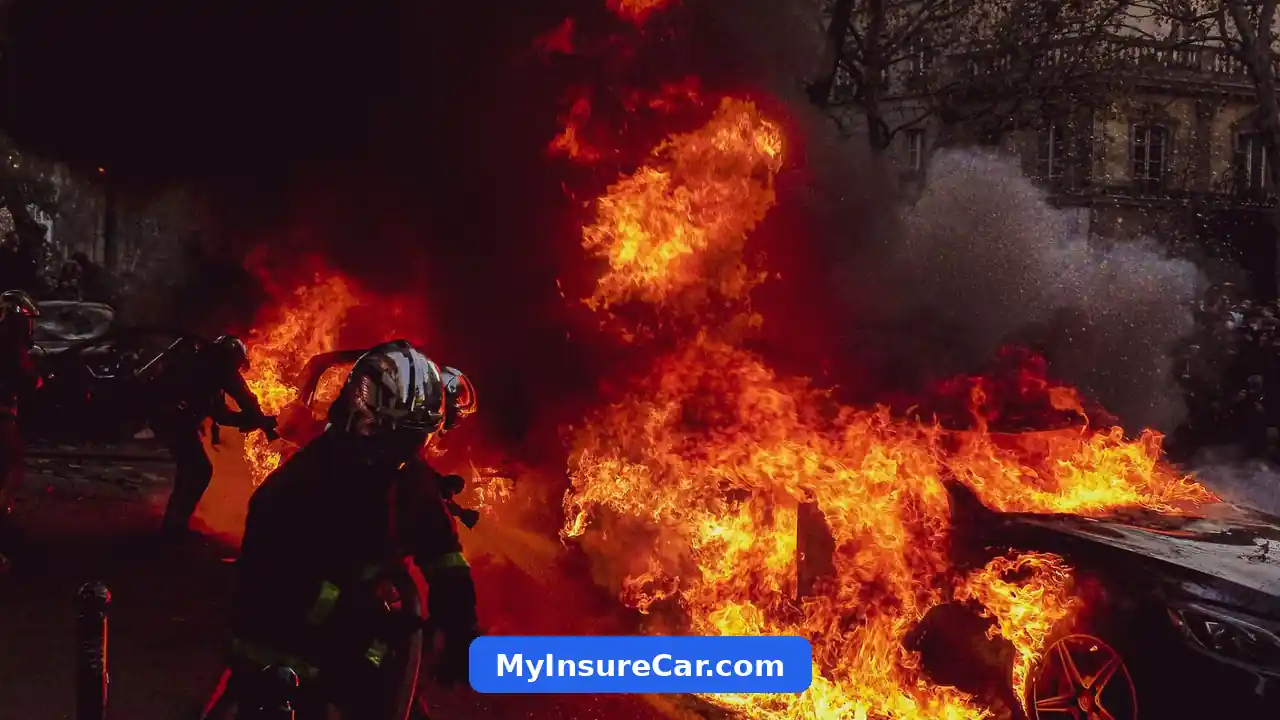
You smell it first, then you see the smoke curling from under the bonnet. You pull over, get out, and stand on the verge watching your car burn, phone in your hand, thinking: please tell me this is covered. The good news, if there is any in that moment, is that car fires are usually covered. The bad news is that the cover depends on one detail you could easily get wrong.
The detail is the type of cover you carry. Liability-only policies do not pay for fire damage to your own car. Comprehensive cover does. That single difference decides whether you get a payout or a bill for a burnt-out shell. If this is you: you are standing there right now, do not open the bonnet and do not go back for your bag. The what-to-do-next section below is written for exactly this minute.
Which coverage pays for a car fire
Your comprehensive coverage pays for fire damage to your own car. It covers fire from any cause that is not a collision: electrical faults, mechanical failure, arson, wildfire, and fires that spread from a neighbouring vehicle or building. If you carry comprehensive, a fire is a covered event for you. You are probably thinking: so why does the investigator ask so many questions? Because fire is the easiest claim to fake, and the investigation section below tells you exactly what to expect.
Your collision coverage does not pay for a fire unless the fire follows a crash. If you hit another car and the impact starts a fire, collision may respond. If your car catches fire while parked, collision does not apply to you.
Your liability coverage never pays for your own car. It pays for damage you cause to other people and their property. A liability-only policy leaves you with nothing when your own car burns. If you carry liability only, understand that clearly before you need it. The comprehensive versus collision insurance comparison sets out exactly what each type does and does not cover.
What causes car fires
So what actually starts these fires? If this is you: your car is older and it has smelled of fuel or blown a fuse twice, check the wiring first. That is your car telling you what is about to happen.
In your older car, electrical faults are the most common cause. Your wiring degrades, connections corrode, and aftermarket accessories are often wired badly. A stereo, a light bar, or a phone charger fitted without care can overheat a circuit that was never designed for the extra load.
Mechanical problems come next for you. Fuel leaks are the most dangerous, because leaking fuel plus a hot exhaust is a fire waiting to happen. Oil leaks onto hot parts can ignite too. If your car smells of fuel or leaves wet patches under the engine bay, it needs attention before it needs a fire crew.
Arson and vandalism cause a smaller share of fires, but they are the most likely to be investigated hard. Your insurer knows that a car worth less than the loan on it is a temptation. It will look carefully at any fire where you benefit financially. You are probably thinking: are they accusing me? No. That is not suspicion of you personally. It is how the business works, and an honest, well-documented claim sails through it.
Wildfires are a growing cause in several states. Your car parked in the path of a wildfire is covered by comprehensive, just like any other fire. If you live in a fire-prone area, comprehensive is not optional for you. It is the cover that stands between you and a total loss.
What to do when it happens
Get away from the car and call the fire service. Do not open the bonnet. Opening it feeds oxygen to the fire and can cause a flare-up. Do not try to save belongings from inside. Part of you wants to run back for your laptop or your bag. Do not. Cars can be replaced. People cannot, and nothing in that car is worth you.
Once the fire is out, do not move the car or disturb the scene more than you must. The insurer and possibly the fire investigator will want to see the car as it is. Take photos from a safe distance if you can do so without getting in the way.
Call the police if the fire looks deliberate or if it happened in a public place. A police report helps the claim, and it is required by most insurers for fires that may involve arson or vandalism.
Filing the claim
Report the fire to your insurer as soon as you safely can. Tell them what happened, where the car is, and whether the police or fire service attended. They will open a claim and send an adjuster or an investigator to inspect the car.
Gather what you can. The police report number, the fire service incident number, photos of the car, the registration, and any service records you have. Service records matter more than you may expect, because they show the car was maintained and that the fire was not caused by neglect.
Your insurer will decide whether your car is a total loss. A fire that reaches the cabin or the engine bay usually is. Your payout is the car’s actual cash value, minus your deductible, if the claim is accepted. The filing a car insurance claim properly page walks through the whole process, including what to do if the first offer is too low.
How insurers investigate fire claims
Your fire claim will get more scrutiny than most claims, because fire is one of the easiest ways to fake a total loss. Expect questions. They are normal, and they are not an accusation.
The investigator will look for your fire’s origin and cause. An electrical fire leaves different marks from a fuel fire, and an accelerant leaves traces that a laboratory can find. The investigator will also check your car’s history: recent repairs, recent valuations, the loan balance, and whether the car was advertised for sale.
Be honest and be patient. Answer questions directly, hand over the records you have, and do not guess about things you do not know. A claim that looks straightforward and well documented gets paid faster than one where the owner is vague or defensive. You already know the answer here: the calmer and clearer you are, the faster your payout lands.
For the industry background on how fire claims fit into comprehensive cover, the Insurance Information Institute explains what comprehensive policies do and do not cover.
If the claim is denied
If your claim is denied, it usually falls into a few categories. The most common is that your policy did not include comprehensive cover. If you carried liability only, there is no claim to argue. The second is that your insurer believes the fire was deliberate. The third is a policy exclusion, such as a modification you did not tell your insurer about.
Ask for the denial in writing, with the specific policy language the insurer is relying on. Read it. If the reason is a missing cover you genuinely did not buy, the denial will stand. If the reason is disputed, you can appeal inside the company, complain to your state insurance department, and, for larger amounts, consult a lawyer.
Keep every document. The denial letter, the policy, the photos, and the service records are your case if you challenge the decision. For the regulatory route, the National Association of Insurance Commissioners can point you to your state department’s complaint process.
Preventing the next one
Maintenance is your best prevention. Fix fuel smells immediately. Have wiring checked if fuses keep blowing or lights flicker. Never ignore a burning smell, a warning light, or smoke from under the bonnet. Pull over, switch off, and get out.
Be careful with your aftermarket accessories. Anything that draws power should be fitted properly, with the right fuse and the right gauge of wire. A cheap fitting job is a fire risk that saves a few dollars and risks the whole car.
Do not carry flammable liquids in your car. Fuel cans, solvents, and gas cylinders belong in proper storage, not in your boot. One leak in a hot car is enough to start a fire that no one can stop in time.
If someone deliberately set fire to your car, that falls under a different part of your policy. The page on whether car insurance covers vandalism explains how malicious damage claims work.
Frequently Asked Questions
Will my insurance cover it if my car catches fire?
Yes, if you carry comprehensive coverage. Comprehensive pays for fire damage to your own car from any non-collision cause. A liability-only policy will not pay for fire damage to your own car.
What should I do first if my car catches fire?
Get away from your car, move everyone to a safe distance, and call the fire service. Do not open your bonnet, because that feeds oxygen to the fire, and do not try to rescue belongings from inside. Your first job is getting yourself safe, not saving the car, and that is the one decision you must get right.
What documents do I need for a car fire insurance claim?
You need the police report number, the fire service incident number, photos of your car, your registration, and any service records you have. Your service records help show your car was maintained and your fire was not caused by neglect.
How can I prevent car fires?
Fix fuel smells immediately, have your wiring checked if your fuses keep blowing, fit aftermarket accessories properly, and never carry flammable liquids in your car. If you ever smell burning or see smoke from under your bonnet, pull over and get out.
What if my car fire claim is denied?
Ask for the denial in writing with the specific policy language relied on. You can appeal inside the company, complain to your state insurance department, and consult a lawyer for larger amounts. Keep every document.
A car fire is frightening, but the insurance side is straightforward. Comprehensive cover pays, liability-only does not, and a clean, honest claim gets paid. Check your policy today, before you need it, and fix the small faults that start most fires.

[…] Also read: My Car Caught On Fire Will My Insurance Cover It? […]
[…] Are you curious about: My Car Caught On Fire Will My Insurance Cover It? […]
[…] Claims during storage are common. Typical scenarios include theft, fire, storm damage, and vandalism.If comprehensive-only coverage is active, claims are usually handled normally. If coverage was canceled, the loss is uninsured.For fire-related scenarios, coverage rules are explained here: https://myinsurecar.com/my-car-caught-on-fire-will-my-insurance-cover-it/ […]
[…] key to answering “Does car insurance cover vandalism?” lies in one specific type of coverage: comprehensive insurance. This is the only […]
[…] does car insurance cover windshield replacement? In the vast majority of cases, the answer is yes—especially if you […]
[…] should also consider lower deductibles. Unexpected repair bills can derail budgets, and having insurance cover most of the cost provides valuable financial cushioning during vulnerable […]
[…] directly or through higher premiums. If you’ve ever wondered how to avoid car insurance fraud, the answer starts with awareness, vigilance, and smart habits. Fraudulent claims cost the […]
[…] for car insurance, you’re not just looking for any policy—you want the best car insurance for drivers over 50: affordable, reliable, and tailored to your life stage. At this point in life, […]
[…] a credit check—but it depends on where you live and which insurer you choose. In most states, insurance companies use your credit-based insurance score as part of their pricing model. However, several […]
[…] to help college students and their families choose affordable, reliable, and comprehensive auto insurance that fits their unique […]
[…] does car insurance cover flood damage? The answer hinges entirely on your policy type. If you’ve invested in […]
[…] to know how different coverage types work in unique scenarios. For example, see what happens when Your Car Catches Fire or how coverage applies to Accidents on Private […]
[…] your car is totaled and you’re wondering what comes next, see my post on what happens when your car catches fire. It covers total loss claims and settlements in […]
[…] Coverage rules vary by cause. See whether insurance covers a car fire. […]
[…] bike insurance cover […]