You’ve just bought a new car, or maybe you’re reviewing your current policy, and you keep hearing about comprehensive vs collision insurance. What’s the difference? Which one do you actually need? If you’ve ever wondered whether these two coverages protect the same things or serve completely different purposes, you’re not alone. Many drivers confuse them, assume they’re interchangeable, or worse, go without one and regret it later.

collision insurance covers damage to your vehicle when you hit another car or object, like a guardrail or pothole. Comprehensive insurance, on the other hand, protects against non-collision events, think theft, vandalism, hail, fire, or hitting a deer. While both are optional if you own your car outright, they’re often required by lenders if you’re financing or leasing. Understanding the distinction between comprehensive vs collision insurance can save you thousands in unexpected repair costs and give you peace of mind on the road. Your state insurance department publishes guides explaining these two coverages.
Breaking Down Collision Insurance: When It Pays
Collision insurance is designed to cover damage to your vehicle resulting from a crash, whether it’s with another vehicle, a stationary object, or even flipping over. It doesn’t matter who’s at fault; collision coverage kicks in to repair or replace your car up to its actual cash value, minus your deductible.
For example, imagine you’re driving home during rush hour and accidentally rear-end the car in front of you at a red light. Your bumper is cracked, the headlights are shattered, and the hood is bent. Without collision coverage, you’d foot the entire repair bill yourself. But with it? Your insurer handles the cost after you pay your chosen deductible, say, $500 or $1,000.
This type of coverage is especially valuable for newer or more expensive vehicles, where repair costs can run into the thousands. Even if you’re a cautious driver, accidents happen, and collision insurance ensures you’re not left stranded with a hefty mechanic’s invoice.
Common Scenarios Covered by Collision
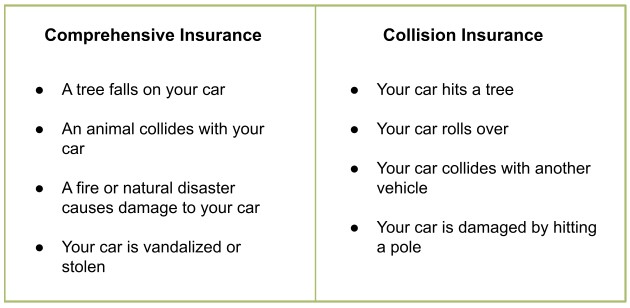
- Hitting another car, front, side, or rear impact
- Crashing into a tree, pole, wall, or fence
- Rolling your vehicle in an accident
- Damage from potholes or road debris that causes loss of control
- Single-vehicle accidents where no other party is involved
Note that collision does not cover injuries to people, that’s what bodily injury liability is for. It also won’t pay for mechanical failures, normal wear and tear, or damage from non-crash events like flooding or theft.
Understanding Comprehensive Insurance: Protection Beyond Crashes
While collision handles crash-related damage, comprehensive insurance steps in for everything else that can harm your car, outside of a collision. Think of it as “all the other stuff” coverage. It’s often called “other than collision” coverage for this reason.
Comprehensive insurance protects your vehicle from risks that are largely out of your control. Whether it’s a hailstorm denting your roof, a thief breaking your window to steal your GPS, or a fallen tree branch crushing your windshield, comprehensive has your back.
One real-world example: You park your car overnight in your driveway. A severe thunderstorm rolls through, and golf-ball-sized hail pounds your vehicle, leaving dents across the hood, roof, and trunk. Without comprehensive coverage, you’d pay out of pocket for paintless dent repair or panel replacement. With it? Your insurer covers the repairs after your deductible.
What Comprehensive Typically Covers
- Theft of your vehicle or parts (like catalytic converters)
- Vandalism: keying, graffiti, smashed windows
- Natural disasters: hail, windstorms, floods, wildfires
- Falling objects: tree branches, rocks, construction debris
- Animal collisions: hitting a deer, dog, or bird
- Glass damage (windshield cracks or chips)
- Civil disturbances like riots or explosions
Like collision, comprehensive pays up to your car’s actual cash value minus your deductible. It also doesn’t cover personal belongings stolen from your car, those fall under homeowners or renters insurance.
Comprehensive vs Collision Insurance: Side-by-Side Comparison
To truly grasp the difference between comprehensive vs collision insurance, it helps to see them compared directly. While both are types of physical damage coverage and often bundled together, their triggers and protections are distinct.
| Feature | Collision Insurance | Comprehensive Insurance |
|---|---|---|
| Trigger Event | Collision with another vehicle or object | Non-collision events (theft, weather, animals, etc.) |
| At-Fault Requirement | No, covers you regardless of fault | No, covers you regardless of fault |
| Common Examples | Rear-ending another car, hitting a mailbox, skidding into a ditch | Hail damage, car theft, windshield crack from flying rock, hitting a deer |
| Deductible Applies? | Yes | Yes |
| Required by Lenders? | Usually yes, if financing/leasing | Usually yes, if financing/leasing |
| Average Annual Cost (U.S.) | $300-$600 | $150-$350 |
This table clarifies that while both coverages protect your vehicle’s physical condition, they respond to entirely different kinds of incidents. Choosing one without the other leaves significant gaps in protection.
Do You Really Need Both?
Here’s the million-dollar question: Should you carry both comprehensive and collision insurance? The answer depends on your vehicle’s value, your financial situation, and your risk tolerance.
If you drive a brand-new sedan worth $35,000, skipping either coverage could be financially risky. A single hailstorm or fender bender could cost more than a year’s worth of premiums. In this case, having both is a smart move.
But what if you drive a 12-year-old compact car valued at $3,000? Paying $800 a year for both coverages might not make economic sense, especially if you have enough savings to cover a total loss. Many drivers in this situation drop one or both to save money, accepting the risk.
However, if you’re leasing or financing your vehicle, your lender will almost certainly require both. They want to protect their asset until the loan is paid off. Dropping coverage could violate your contract and lead to forced placement of insurance, often at much higher rates.
Another factor: your deductible. Higher deductibles lower your premium but increase out-of-pocket costs when you file a claim. Choose a deductible you can comfortably afford in an emergency.
How Much Does Comprehensive vs Collision Insurance Cost?
Costs vary widely based on location, driving history, vehicle type, age, and coverage limits. On average, U.S. drivers pay between $300 and $600 annually for collision and $150 to $350 for comprehensive. That’s a combined range of $450 to $950 per year, or about $38 to $79 per month.
Why the difference? Collision tends to be more expensive because crashes are more common, and often more costly, than theft or weather events. High-risk areas (like urban centers with heavy traffic or high crime rates) also see higher premiums.
Your car’s make and model matter too. Luxury vehicles, sports cars, and models with high repair costs typically cost more to insure. Conversely, safe, economical cars with good theft deterrents may qualify for discounts.
You can reduce costs by:
– Increasing your deductible (e.g., from $500 to $1,000)
– Bundling with home or renters insurance
– Maintaining a clean driving record
– Installing anti-theft devices (for comprehensive discounts)
– Taking a defensive driving course
Always get quotes from multiple insurers. Rates can differ by hundreds of dollars for the same coverage.
Real-Life Examples: When Each Coverage Matters
Let’s look at two common scenarios to illustrate how comprehensive vs collision insurance works in practice.
Scenario 1: The Parking Lot Fender Bender
Maria parks her SUV in a busy mall lot. When she returns, she finds a deep scratch along the driver’s side door, clearly from someone else’s careless parking. There’s no note, no witness. She files a claim under her collision coverage. Her insurer pays for the paint and bodywork after her $750 deductible. Without collision, she’d pay $1,200 out of pocket.
Scenario 2: The Midnight Hailstorm
James leaves his convertible parked outside during a summer storm. Overnight, hail the size of marbles pelts the car, leaving dozens of dents. He files a claim under his comprehensive coverage. The repair costs $2,800, but he only pays his $500 deductible. Without comprehensive? He’d be writing a big check himself.
These examples show how each coverage fills a unique gap. Relying on just one leaves you exposed to the other’s risks.
Key Takeaways: Making the Right Choice
- Collision insurance covers damage from crashes with cars, objects, or rollovers, regardless of fault.
- Comprehensive insurance covers non-collision damage from theft, weather, animals, vandalism, and more.
- Both are usually required if you’re financing or leasing a vehicle.
- For older, low-value cars, you may opt out, but only if you can afford to replace the vehicle outright.
- Always consider your deductible, vehicle value, and personal risk tolerance before dropping coverage.
- Bundle both for full physical damage protection and often receive a multi-policy discount.
Understanding the difference between comprehensive vs collision insurance isn’t just about checking boxes on a policy, it’s about protecting your financial well-being. One bad storm or distracted driver could total your car. With the right coverage, you’re not just insured, you’re prepared.
Frequently Asked Questions
Is comprehensive insurance worth it if I park in a garage?
Yes, even garaged cars aren’t immune to risks like fire, flooding, or theft (especially of parts like catalytic converters). Comprehensive coverage provides valuable protection regardless of where you park.
Will my insurance go up if I file a claim for comprehensive or collision?
It depends on your insurer and state laws. Collision claims are more likely to increase your premium, especially if you’re at fault. Comprehensive claims (like hail damage) often have less impact, as they’re considered “acts of God” or outside your control.
Can I have comprehensive without collision?
Yes, technically, but most insurers require both if you’re financing. If you own your car outright, you can choose one over the other, though it’s rarely advisable unless your car has very low value.
How do I choose the right deductible for comprehensive and collision?
Choose a deductible you can comfortably afford to pay out of pocket after a claim. A higher deductible lowers your premium but increases your upfront cost. Review your emergency savings and vehicle value to find a balance that suits your budget.
Can I drop comprehensive or collision to save money?
Yes, if you own your car outright and its value is low, you may drop one or both coverages to reduce premiums. Weigh the annual cost against your car’s actual cash value to decide if the saving is worthwhile. If you are financing or leasing, your lender will usually require both.
When it comes to protecting your vehicle, knowledge is power. Now that you understand the critical differences between comprehensive vs collision insurance, you can make informed decisions that align with your needs, budget, and peace of mind. Don’t wait for disaster to strike, review your policy today.