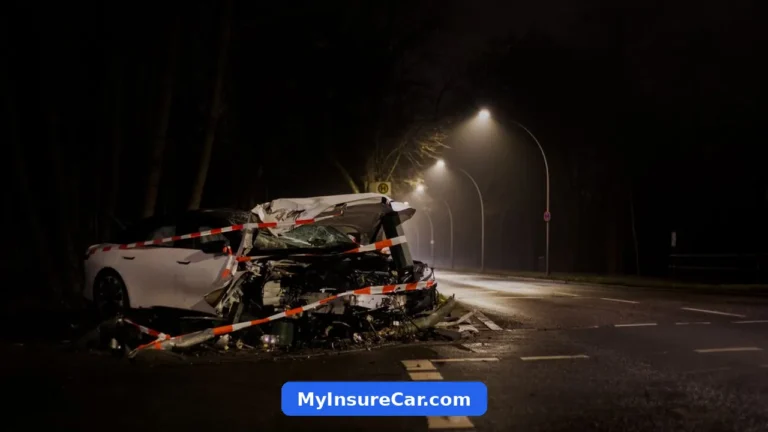
You walk back to your parked car and find the wing mirror smashed and paint scraped down the door. No note, no witness, no other car in sight. Or worse: a driver clips you at night and speeds off before you can read the plate.
It is infuriating, because the person responsible is gone and you are left with the damage. But a missing driver does not mean you have no options. Your own insurance can still pay, if you take the right steps in the right order.
You are probably thinking: the driver is gone, so who pays for this? Your own cover does, if you take the right steps in the right order. Here is your order of operations, starting with the next five minutes.
Immediate steps at the scene
Your first job is safety, not detective work. You are probably thinking: should I follow them and get the plate? No. Never chase a fleeing driver. It puts you in danger and can create legal trouble of its own.
Once you are safe, work through the steps below.
Move to a safe spot and switch on your hazard lights. Call the police and report it as a hit-and-run. Note everything you saw: the time, the location, the direction of travel and a description of the vehicle.
Look for witnesses and ask for their contact details. Check for nearby cameras, including shop cameras, doorbell cameras and dashcams. Write down the partial plate if you caught even a few characters.
If anyone is hurt, call emergency services first and do not move injured people unless they are in danger. Your health comes before the claim, and a medical record made on the day is far stronger evidence than one made a week later.
Why the police report is critical
Your police report is the backbone of your hit-and-run claim. Without it, your insurer has only your word that the damage was caused by another driver, and that is rarely enough. With it, your claim becomes a documented hit-and-run.
If this is you, the one who found the damage hours later and wondered if it was too late, it is not. File the report promptly, ideally on the day. Give the officer everything you noted, including the partial plate and the camera locations you spotted. Get the report number before you leave, and keep it with your claim paperwork.
If the damage happened while your car was parked and you found it later, report it as soon as you discover it. A delay of days makes your claim harder, because your insurer will ask why you waited.
Evidence that strengthens your claim
Your photos are your best evidence. Photograph the damage from several angles, the position of your car, the road surface, debris on the ground and any paint transfer. Photograph the wider scene too, because it shows the context your adjuster needs.
Witness statements help your claim enormously. A stranger who saw the other car, or a shopkeeper whose camera caught it, can turn your thin claim into a solid one. But photos alone do not pay you. What pays you is which cover applies, and that is next.
Dashcam footage is decisive when it exists. If you have a dashcam, save the clip immediately so it is not overwritten. If a nearby business has cameras, ask for the footage the same day, before it is deleted.
The Insurance Information Institute explains how to document a car accident for a claim in terms that apply directly to your hit-and-run.
Dealing with your insurer after a hit-and-run
Report your claim promptly, with the police report number in hand. You are probably thinking: will they even believe me with no other driver to blame? That number is what makes them believe you. The first thing the person on the phone will ask for is that number, so have it in front of you before you dial. Stick to the facts you know. Do not guess at the other car’s speed, colour or plate if you are unsure.
A wrong guess that later proves false damages your credibility far more than an honest gap. I do not know is a perfectly good answer on a claims call.
Keep a log of every call: date, time, who you spoke to, and what was agreed. If your claim drags on, that log is what gets you taken seriously. If your insurer disputes the claim, your log plus your police report plus your photos are your case.
The National Highway Traffic Safety Administration publishes guidance on what to do after a crash, including hit-and-runs. It is a useful checklist to read before you call your insurer.
And if the accident was not your fault, knowing what happens after a car insurance claim will tell you what to expect in the weeks that follow.
Which coverage pays for hit-and-run damage
Once you have reported it, here is what pays. The answer depends on what cover you carry and what your state allows. Three coverages do most of the work.
Uninsured motorist cover is your main one. In many states, a hit-and-run driver counts as an uninsured motorist, which means your uninsured motorist cover pays for your injuries and, in some states, your car damage too. The rules vary, so check your state’s treatment.
What uninsured motorist coverage is explains the property and injury sides separately.
Collision cover pays for damage to your own car regardless of who caused it, subject to your deductible. If you carry collision, it is usually your simplest route to a repaired car, even when the other driver is unknown.
Comprehensive cover sometimes applies, mainly when your car was parked and the damage could be treated as vandalism rather than a collision. Your insurer will tell you which bucket your claim falls into. That answer also decides your deductible, which is what we turn to next.
How deductibles work here
Deductibles apply to your hit-and-run claim under collision and comprehensive cover, and the amount is the one on your policy. A high deductible can make a small hit-and-run claim pointless, because your repair costs little more than the deductible.
Uninsured motorist property cover sometimes carries a smaller deductible, or none at all, depending on the state. Ask your insurer which deductible applies to your specific claim before you decide whether to file. A claim that nets you almost nothing still counts as a claim on your record.
Do the arithmetic before you file. If your repair costs only slightly more than your deductible, paying out of pocket keeps your claims history clean and may save you more in future premiums.
What if the driver is found later
Hit-and-run drivers are sometimes found later, through a plate, a camera, or a repair shop report. If yours is found, your insurer may recover what it paid you from the other driver’s insurer, a process called subrogation.
Subrogation can work in your favour. If your insurer recovers your deductible, you may get it refunded. If the other driver is uninsured, recovery is harder, but your uninsured motorist cover has already done its job.
Keep your evidence even after your claim closes. If the driver is found months later, your photos, your police report and your witness details become relevant again.
Will it raise your rates?
It depends on your claim type and your state. A hit-and-run claim paid under uninsured motorist cover is often treated as not-at-fault, which limits the effect on your rates. A collision claim may affect your rates more, because your insurer paid without anyone to recover from.
Some states restrict rate increases after not-at-fault claims. Others leave it to your insurer. If this is you, the one lying awake wondering if your premium jumps now, ask your insurer directly how your claim will be treated at renewal, and compare quotes if the answer is a large increase.
Filing a car insurance claim properly covers the timing and the wording that protect your record.
When to speak to a lawyer
Most hit-and-runs are handled without a lawyer. But if someone was hurt, if your insurer disputes your claim, or if the other driver is found and the case becomes a legal matter, legal advice is worth the cost.
Many personal injury lawyers offer a free first consultation for crash cases. Use it to understand your position before you commit to anything. Bring your police report, your photos and the letters from your insurer. No article can tell you whether your case needs a lawyer. That free consultation can, and it costs you nothing but an hour.
You did not cause this, and you should not be left carrying the bill for someone who drove away. Your next step depends on where you are: if you are still at the scene, call the police now and start your photos. If you are already home, file that report today, then let your own cover do the work while the search for the other driver goes on.
Frequently Asked Questions
Should I call the police for a minor hit-and-run with no injuries?
Yes. The police report is the backbone of your claim, and most insurers require it. A minor hit-and-run without a report is much harder to claim on.
What if the hit-and-run happened while my car was parked and I saw nothing?
Report it to the police as soon as you discover it, photograph the damage, and check for nearby cameras and witnesses. Your collision or uninsured motorist cover may pay, depending on your state.
Does uninsured motorist coverage apply to hit-and-runs in every state?
No. In many states a hit-and-run driver counts as uninsured, but the rules and the property-damage treatment vary. Check your state rules and your policy before you assume.
How long do I have to file a hit-and-run claim?
Report it to the police immediately and to your insurer promptly. Policy deadlines vary, and delay makes your claim harder, so file within days rather than weeks.
Can I still claim if I only carry liability insurance?
Usually not for your car. Liability-only pays others, not you. Without collision or uninsured motorist cover, the repair bill is yours unless the other driver is found.
What to do in a car accident?
Stay safe, check for injuries, call emergency services if anyone is hurt, call the police, document the scene, and notify your insurer promptly. Never chase a fleeing driver.