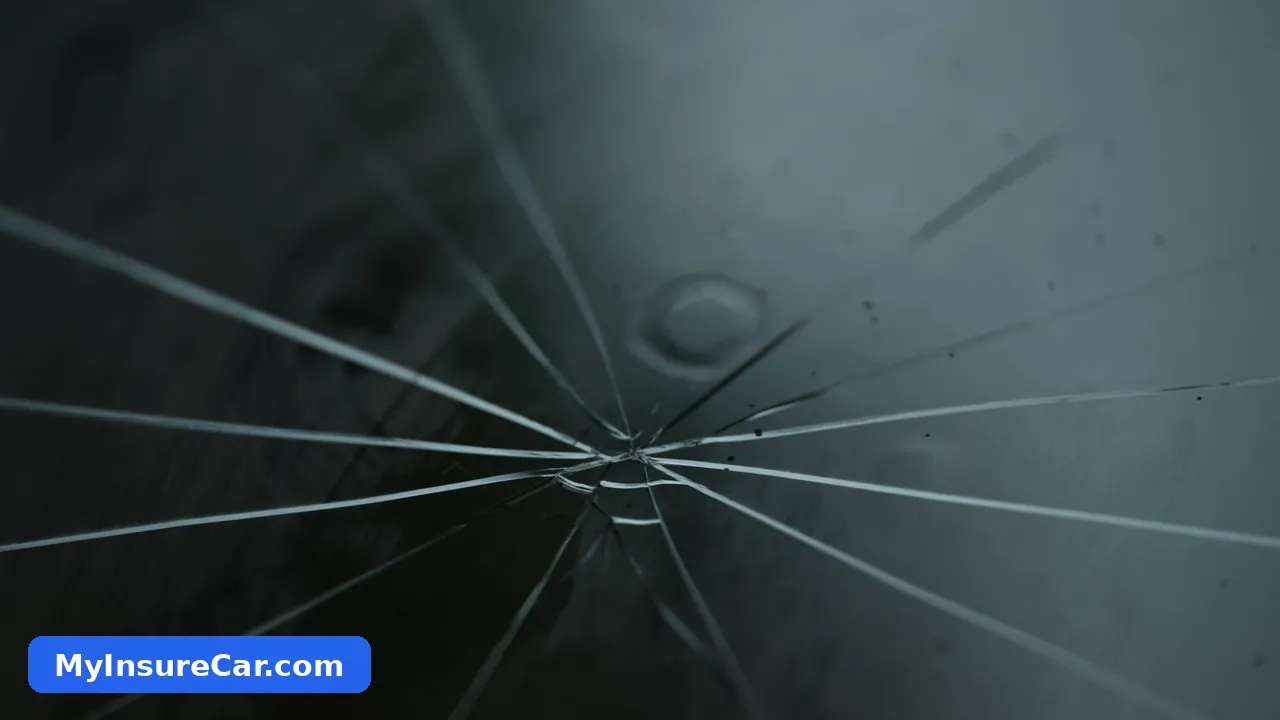
You are driving home, radio on, not thinking about anything. Then a sharp tick. A stone flicks up from the lorry ahead, and suddenly there is a star-shaped crack spreading across your windscreen, right in front of you. You stare at it. You are probably thinking: can I just leave it? Will it get worse? And who pays for this?
The first question is always the same: will insurance pay for this? Usually, yes, but how much you pay out of pocket depends on your cover, your deductible, and your state. The good news is that this is one of the cheapest insurance problems you will ever have, as long as you make one move quickly. Keep reading and you will know whether your policy pays, what you pay out of pocket, and the one move that keeps a cheap chip from becoming a full replacement.
Comprehensive cover pays for glass damage
Comprehensive coverage is the part of your policy that pays for glass damage. It handles non-collision events: stones, hail, falling branches, vandalism, and anything else that cracks glass without a crash involved. If you carry comprehensive, a cracked windscreen is normally a straightforward claim for you.
Liability-only cover will not help you here. It pays for damage you cause to other people, never for your own car. If you carry only liability, a cracked windscreen is entirely your bill, which is one more reason to think carefully before choosing liability-only cover.
Many insurers go further and include full glass cover inside comprehensive, sometimes with no deductible at all. That can mean a free repair or replacement for you. Check your policy documents for the words “full glass” before you assume anything. Part of you wants to just call the insurer and ask. You already know the answer, you just do not want to dig out the paperwork: two minutes with your policy documents tells you whether this crack costs you nothing or a few hundred.
What kind of damage is covered
Insurers generally cover chips, cracks, star breaks, and edge cracks, as long as the cause is a covered peril. Small chips under an inch can usually be repaired with resin. Cracks longer than about six inches, damage in the driver’s line of sight, or cracks near the edge typically require full replacement on safety grounds.
If this is you, the one with a tiny chip you keep telling yourself you will deal with next week, this section is about you. The difference between comprehensive and collision insurance is exactly this: comprehensive covers the stone that hit your windscreen, while collision covers the crash that damaged your bumper. Glass claims almost always fall on the comprehensive side, which is good news for you. But whether your claim is approved depends on three things, and the first one is in your hands.
What decides whether your claim is approved
Your policy type and deductible
With comprehensive cover and a $0 glass deductible, you pay nothing. With a standard $500 deductible and a $350 repair, you pay the whole bill yourself and should not even file. Do the arithmetic before calling: if the repair costs less than your deductible, filing achieves nothing except paperwork for you.
State rules
A few states, including Florida, Kentucky, and South Carolina, require insurers to repair or replace windscreens with no deductible when the damage comes from a covered peril. These laws exist because prompt glass repair is a safety issue. Your state insurance department publishes the exact rules, so check before you pay. If you live in one of those states, your crack might be free, and you would never know unless you checked.
Cause of the damage
A rock kicked up by a lorry, hail, or vandalism: covered. Gradual wear, a manufacturing defect, or damage you caused deliberately: usually not. Document what happened with a photo and report promptly. Claims go smoother when the cause is clear and recent. So now you know whether you are covered. The next question is the one that decides your bill: repair or replacement?
The camera behind the glass: ADAS recalibration
If your car has a forward-facing camera behind the windshield, for lane keeping, adaptive cruise, or automatic braking, replacing the glass means recalibrating that camera. Recalibration typically adds $150 to $600 to the bill, and on some vehicles the total job reaches $600 to $1,500. The camera must be realigned precisely or the safety systems will not work as designed, and skipping the step is not an option on a car that depends on it.
The glass itself matters too. OEM glass, made to your car maker’s exact specification, usually costs $400 to $1,500, while aftermarket glass that meets federal safety standards usually costs $200 to $300. For a car with ADAS, OEM glass is more likely to calibrate correctly on the first attempt. Check before the job starts whether your policy pays for recalibration, because some comprehensive policies cover it and some treat it as a separate service you pay for. Our guide to how deductibles affect car insurance costs explains the deductible maths behind any glass claim, and our guide to comprehensive vs collision cover sets out where glass sits in your policy.
Repair or replacement
Windscreen repair
Repair means injecting resin into the chip to stop it spreading. It suits small chips and short cracks outside the driver’s direct view, takes under half an hour, and typically costs $50 to $150. Most insurers cover repairs in full even when a deductible would apply to replacement, because a $75 repair today prevents a $400 replacement next month. For you, that means the cheapest fix is also the one your insurer wants you to pick.
Windscreen replacement
Replacement means a whole new windscreen, needed for long cracks, edge damage, or anything blocking the driver’s view. It costs roughly $200 to $500 for standard cars and far more for vehicles with built-in sensors and cameras that need recalibration. Your comprehensive deductible applies unless you have full glass cover or a zero-deductible glass state law.
Tempted to leave a small chip alone? You are probably thinking: it is tiny, it can wait. It cannot. Temperature swings and road vibration make cracks grow, and a repairable chip this week becomes a full replacement next month. Most insurers would rather pay for the cheap repair now, which is exactly why so many waive the deductible for repairs. Acting fast is one of the rare cases where procrastination literally costs you hundreds. So what does the actual claim look like for you?
How to file a glass claim
The process is simpler than most claims. If this is you, the one who has never filed a claim and keeps putting off the call, the whole thing is simpler than you expect. Photograph the damage, note when and how it happened, and call your insurer or start the claim in their app. Most insurers route glass claims to a dedicated glass network, which schedules a mobile technician to come to you. The whole thing often takes less than 48 hours from call to fixed windscreen.
You can usually choose between repair and replacement within the insurer’s guidelines, but let the technician decide: they assess spread risk for a living. Expect one question first, whether the crack sits in your line of sight, because that answer often decides repair or replacement. If you have a preferred glass shop, ask whether it is in the network before booking elsewhere, since out-of-network work can mean more paperwork and slower reimbursement for you. The Insurance Information Institute guide to basic auto cover is a useful refresher on where glass sits within comprehensive before you call.
If you have never filed any claim before, our guide to filing a car insurance claim properly covers the general steps, including what to document and what to say on the call. One worry is probably still sitting in the back of your mind, though: will this claim raise your premium?
A cracked windshield can fail inspection
A crack in the driver’s line of sight is not only a visibility problem. In states with a safety inspection, a cracked windshield can fail the inspection, and in some states driving with it can draw a ticket. The repair limits are practical too: chips up to about an inch across can usually be repaired, while cracks longer than about six inches, damage near the edge, or anything in the driver’s direct view usually means a full replacement.
A glass claim also goes on your CLUE report, the claims history insurers share, so a pattern of claims shows at renewal even when a single claim does not move your premium. One cracked windshield is nothing to worry about; five in two years invites questions, and the insurer may ask whether the car is parked somewhere risky. Fix the chip the week it appears, while it is still a repair, and the claim stays small and simple. Our guide to filing a car insurance claim properly covers the documentation for any claim, and our guide to what happens after a car insurance claim walks through the settlement that follows.
Will a windscreen claim raise your premium
Usually not by much, and often not at all. Comprehensive claims are viewed as bad luck rather than bad driving, so most insurers do not surcharge for a single glass claim the way they do for at-fault accidents. That said, a pattern of frequent comprehensive claims can still mark you at renewal. One cracked windscreen is nothing to worry about; five in two years invites questions.
If your policy already includes full glass cover, you may never think about any of this until the day you need it. If it does not, the next renewal is the time to ask what adding it costs. For you it is usually a small amount, and the first time a lorry throws a stone at your windscreen on the motorway, you will be glad you asked.
One more detail is worth checking before you renew: whether your insurer treats a repair differently from a replacement in its claims history. Many insurers do not count a paid glass repair against you at all, which is one more reason to fix your chip the week it appears rather than waiting for it to spread across the whole windscreen.
Frequently Asked Questions
Does car insurance cover windshield replacement?
Yes, if you have comprehensive coverage. It pays for glass damage from stones, hail, vandalism, and similar non-collision causes. Liability-only policies never cover your own windscreen, so check what you carry.
Will filing a windshield claim raise my rates?
Usually not for you. A single comprehensive glass claim is treated as bad luck rather than risky driving, so most insurers do not surcharge for it. Frequent claims of any kind can still affect your renewal pricing.
Is it better to repair or replace a cracked windshield?
Repair your small chips early: it is cheap, fast, and often fully covered for you. Replace when the crack is long, near the edge, or in your line of sight. Your insurer’s glass shop will advise which applies to you.
Does liability-only insurance cover windshield damage?
No. Liability covers damage you cause to others, never your own vehicle. Windscreen cover requires comprehensive, so check your policy before assuming you are protected.
Which states require free windshield replacement?
Florida, Kentucky, and South Carolina require insurers to repair or replace windscreens with no deductible for covered damage. Check your state insurance department for the current rules where you live.
That crack in front of you is one of the cheapest insurance problems to have, as long as your cover is right. Check whether you have comprehensive and what your deductible is, get the chip repaired this week before it spreads, and ask about full glass cover at your next renewal. A $75 repair today beats a $400 replacement next month.
This guide is general education, not professional insurance advice, so confirm the details in your own policy and with a licensed insurance professional before you act. Full disclaimer